

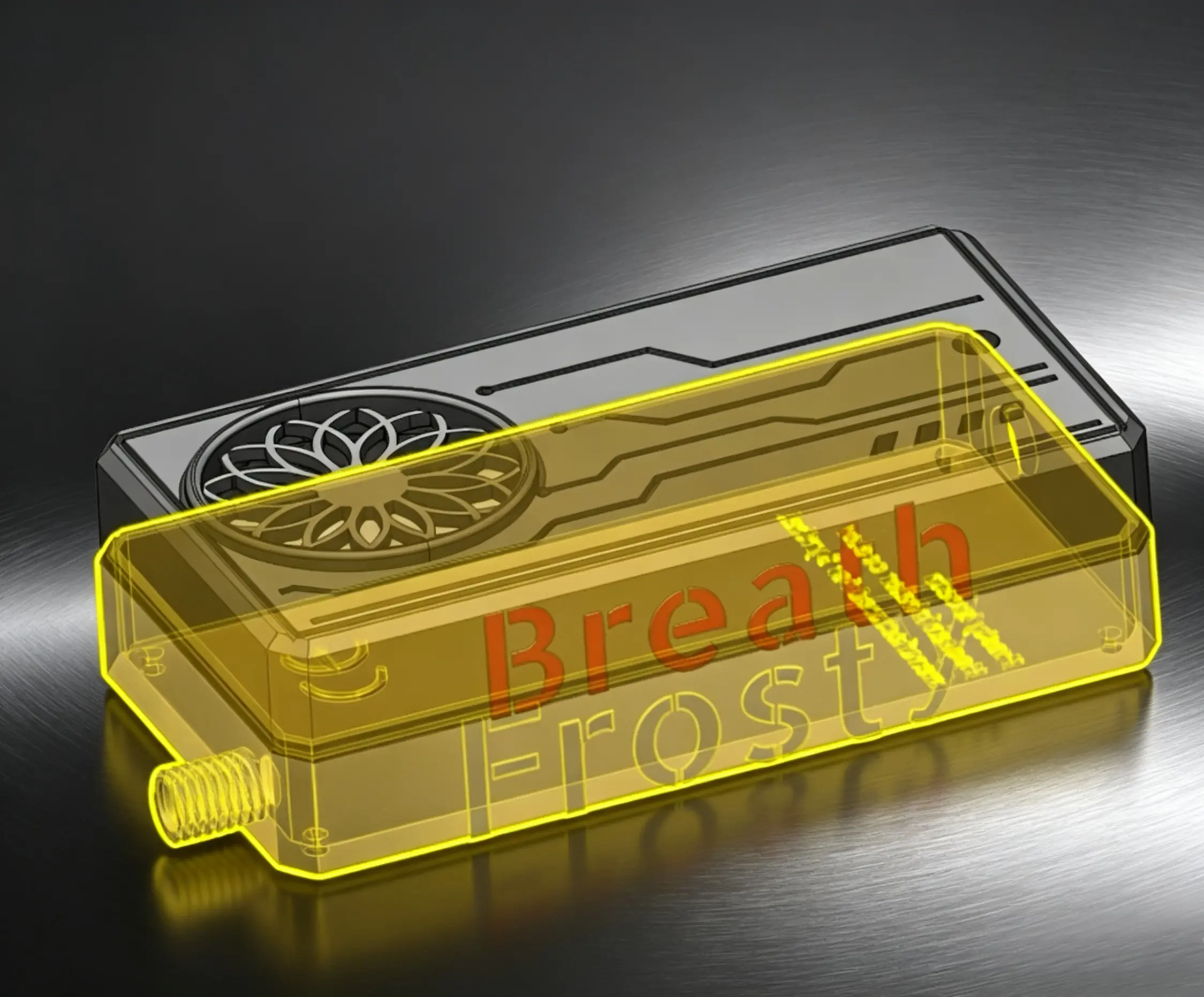

That tiny chip is the heart of the device. It defines the cooling performance, and it set the first boundary for everything else. The design team faced an immediate challenge: the chip’s dimensions and its heat dissipation structure had to align with absolute precision. One extra millimeter meant wasted internal space. One millimeter short meant compromised cooling capacity. Every structural draft was revised, again and again, against the chip’s exacting parameters.
Then came the battery. To deliver true portability without sacrificing runtime, the team tested cells of varying capacities and sizes. Each battery choice forced a recalculation — altering the internal layout, shifting the center of gravity, reshaping the outer shell. The housing was redrawn over a dozen times, each iteration chasing a balance between compactness and performance.
The knob, too, had its own story. The team wanted a mechanical dial with a dynamic colour display — satisfying to touch, responsive to turn. Fitting the display module behind the knob while keeping the profile slim required weeks of prototyping. Every fraction of a millimetre mattered.
What emerged is a device that wears its engineering honestly. The clean, sculpted exterior reflects countless hidden decisions: a chip’s boundary respected, a battery’s weight embraced, a knob’s tactile language perfected.
Good design never announces the struggle behind it. But in every smooth turn of the dial and every cool, quiet draw, the journey reveals itself — a journey that began with a chip, and ended with an experience.